Industrial Labelling Requirements in the UK: What Manufacturers Need to Know About Compliance and Specification
The Supply of Machinery (Safety) Regulations 2008 do not simply require a marking. They require one that is affixed “visibly, legibly and indelibly”. That third word is doing a lot of work, and it is where most labelling non-conformances begin.
Applying a mark is a printing job. Keeping it readable through fifteen years of UV exposure, caustic washdown and vibration is a materials job. A large share of the enquiries that reach us are framed as the first problem and turn out to be the second, usually after an asset has come back from the field with a data plate nobody can read.
There is no single industrial labelling UK standard
Obligations arrive from four directions at once, and they rarely reference each other.
Product regulations set the baseline: the machinery regulations, the Equipment and Protective Systems Intended for Use in Potentially Explosive Atmospheres Regulations 2016, the pressure equipment regulations. Sector standards layer on top, so rail rolling stock carries BS EN and RSSB expectations that a generic industrial plate will not satisfy. Customer specifications add a third layer, and Tier 1 drawing requirements are frequently stricter than the regulation they sit under. Material restrictions such as RoHS and REACH govern what the label itself may contain, which matters for electronics, automotive and rail assemblies.
Compliance labels sit at the intersection. A plate can be correct on content and still fail an audit because the substrate was never rated for the environment it went into.
Where UKCA and CE marking actually stand
Guidance published before 2024 is now misleading, and plenty of it still ranks well.
The Product Safety and Metrology etc. (Amendment) Regulations 2024 removed the expiry date on CE recognition in Great Britain across 21 product regulations, covering machinery, electrical equipment, radio equipment and PPE among others. For those categories, a CE-marked product can be placed on the GB market without a UKCA mark, with no withdrawal date currently set. The same regulations introduced a fast-track UKCA route for manufacturers who have already met the equivalent EU requirements.
Several categories sit outside that recognition, including medical devices, construction products, marine equipment, transportable pressure equipment and rail. Northern Ireland follows EU rules under the Windsor Framework, so the mark that satisfies Great Britain may not satisfy a Belfast delivery address.
None of this reduces the specification question. UKCA marking labels are still written into contracts by distributors and procurement teams who want market-specific evidence, and the marking still has to survive the product’s service life either way. Where things stand today can change, so confirm current status for your product category before you commit a drawing.
What the regulation asks of the label itself
Strip out the sector variation and four requirements repeat.
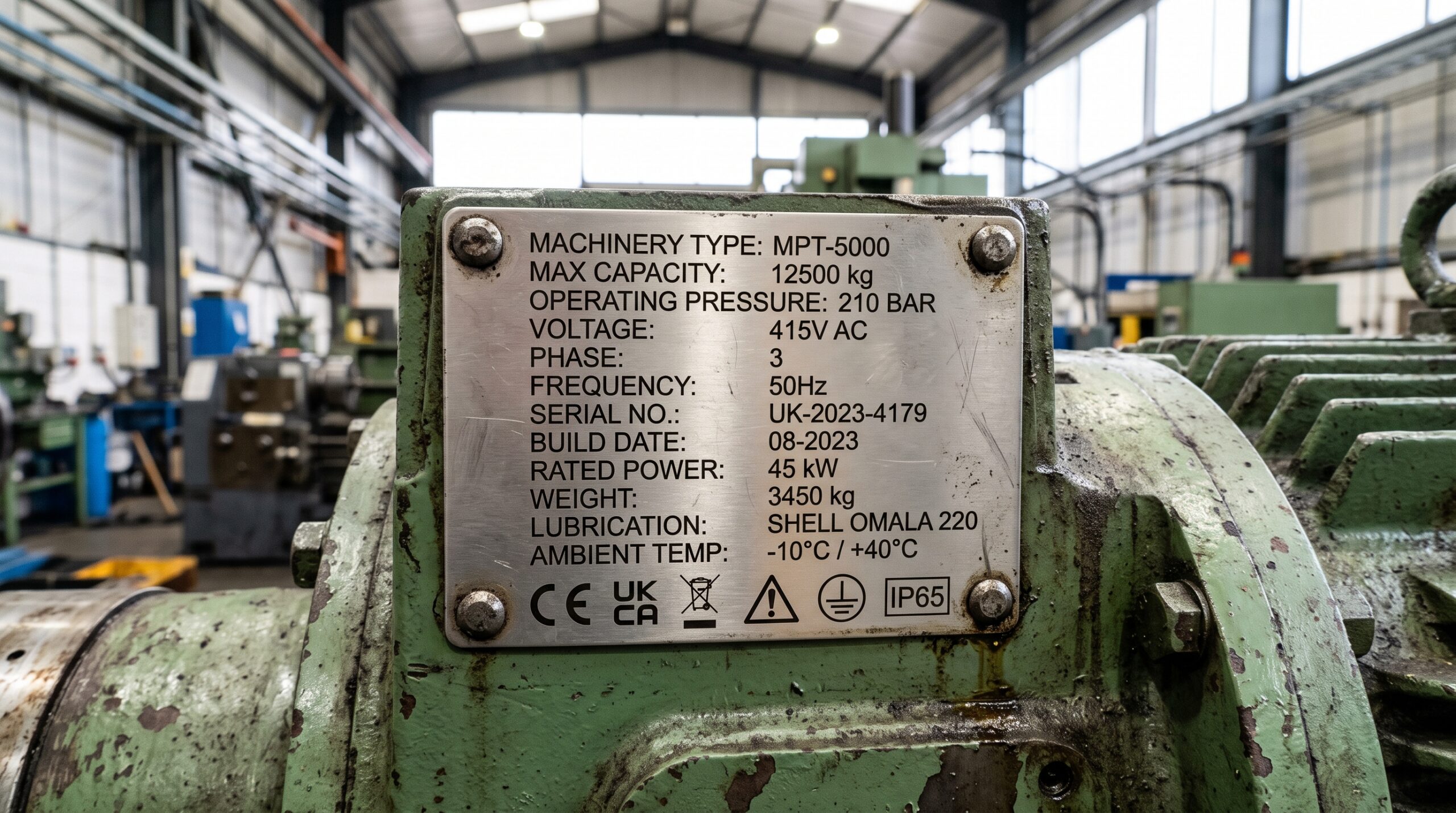
The information has to be present and correct: manufacturer name and address, machine designation, serial or batch identification, year of construction, and any rating data specific to the product. Equipment nameplates for industrial machinery therefore need to be specified around both the required information and the conditions they will face in service. And for identification carrying legal weight, such as VIN and chassis plates, removal or alteration has to leave evidence.
The common failure modes are predictable. Adhesives creep at sustained temperature and the plate begins to lift at a corner. Surface-printed inks lose contrast under solvent cleaning long before the substrate degrades. Polycarbonate can yellow under prolonged UV exposure, reducing legibility. Chemically etched stainless steel, by contrast, has the information formed into the metal, which is one reason it is widely used for ATEX data plates and chassis identification.
Specify for the environment, not for the drawing
The specification decision is often made in five minutes at the end of a design review, using whatever material the previous generation used. That approach can cause problems later if the operating conditions have changed.
Before you select a material, answer these:
- Operating temperature range, including transients and any bake or paint cycle the assembly passes through
- Chemical exposure, including cleaning agents and fluids, which are often more aggressive than the process media
- Outdoor exposure: UV hours, salt spray, freeze-thaw cycling
- Abrasion and handling, particularly for equipment that gets jet washed
- The substrate and fixing method, since adhesive, rivet and screw fixing all constrain material choice
- Required service life of the asset, which for offshore and rail assets may be 20 to 25 years
- The regulatory content that must appear, confirmed against the current version of the relevant standard
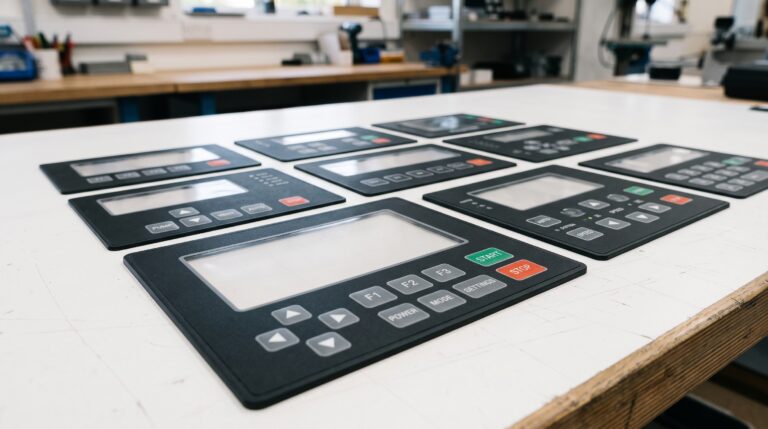
Those answers narrow down the industrial nameplate materials available for the application. Anodised aluminium, where the graphic is embedded into the porous surface by anodic printing, suits outdoor equipment identification and weathering exposure without relying on a surface coating. Chemically etched stainless steel suits high-detail serial data, hazardous-area data plates and applications requiring permanence under chemical attack. Traffolyte engraved laminate suits demanding industrial environments and multi-colour legend work where printed labels may degrade. Polycarbonate and polyester can behave very differently under chemical and UV exposure, making material selection an important specification decision for control panel overlays.
The documentation is half the requirement
An auditor asking about a data plate is rarely asking about the plate. They are also asking how you know the item fitted to the asset matches the specification you approved.
That means material certificates, first-off inspection records, final inspection before despatch, and a retained approved drawing for repeat orders. Lexicraft’s ISO 9001 certified quality management system supports this process, with products manufactured in the Wirral and full material traceability maintained.
Where to start
If you are specifying now, work backwards from the environment and the service life, then check the content requirements against the current regulation rather than the version referenced in your last drawing pack. If the label on your previous generation of product is fading, lifting or unreadable, review the specification before assuming the issue lies with manufacture alone
Lexicraft has been manufacturing precision identification products since 1956, supplying industrial and regulated sectors where durability, traceability and accurate specification matter. If you need to meet a new specification, send us the application rather than only the part number: the environment, compliance requirement, fixing method and quantity. We can then recommend a suitable material and explain why it fits the application.
Send us your application for a technical response and a quotation.