
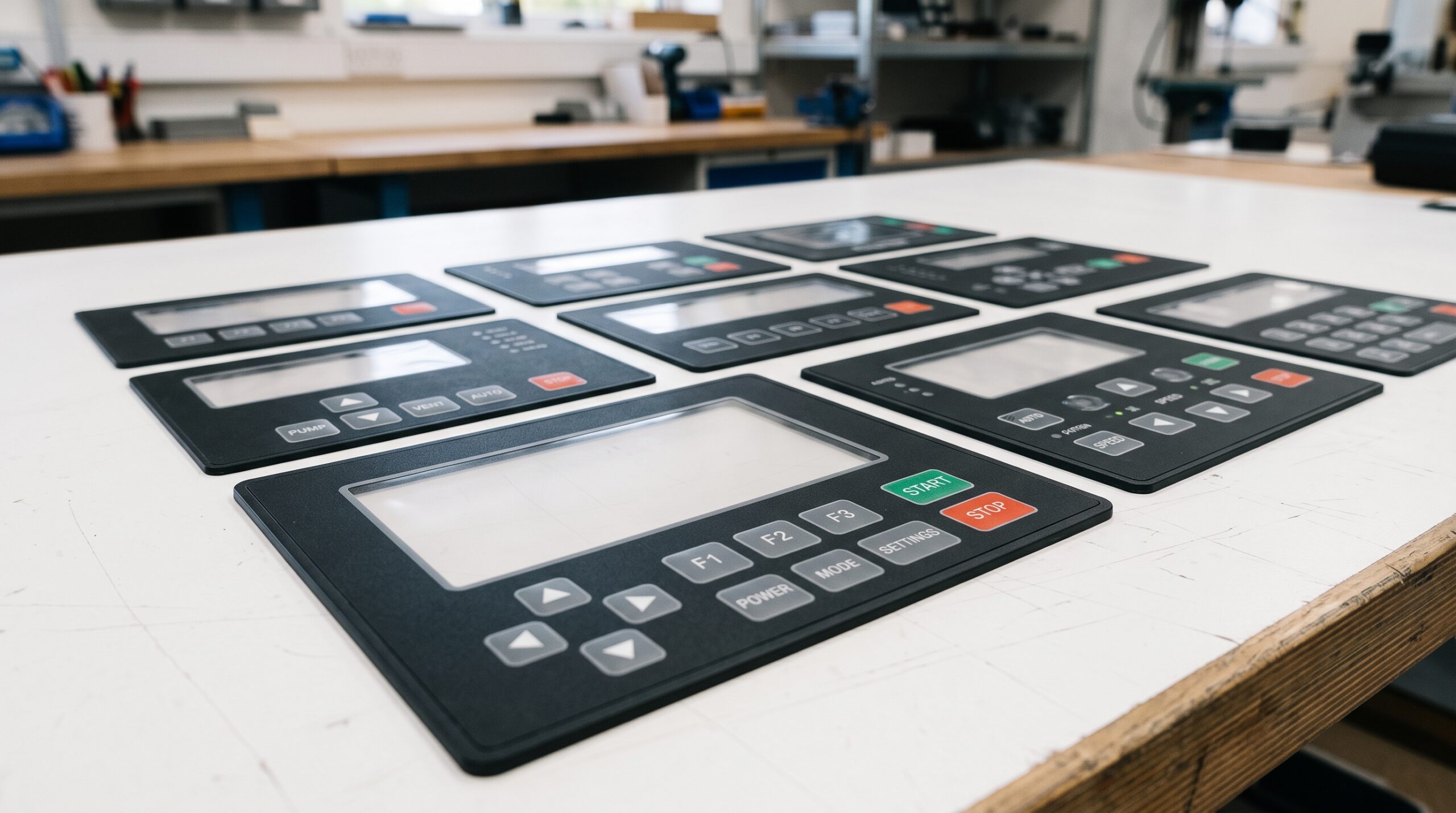
Panel Overlays and Printed Fascia Panels: What They Are, How They’re Made, and What to Specify
Most overlay problems start with a drawing that was never finished. A panel outline, a logo, a few legends, and a note reading “printed fascia, black”. No material called out, no adhesive, no tolerance on the display aperture, and nothing about what the panel gets wiped down with at the end of a shift. The part gets made to that drawing, fits the enclosure and passes goods-in, only for a corner to start lifting months later after a few hundred isopropyl wipes.
At that point, the overlay usually gets the blame rather than the specification behind it.
This article covers what a panel overlay actually is, how one is manufactured, and the information worth having on the drawing before it goes out to quote.
What a panel overlay is
A panel overlay is the printed front face of a control panel or enclosure. It carries the legends, icons and branding, protects what sits behind it from handling and ingress, and gives the operator a visual and tactile reference for the controls.
The terminology varies by sector. Process measurement and control tends to use graphic overlay or panel graphics. Automotive and appliance manufacturers usually say fascia. Front panel overlays, fascia overlays and printed fascia panels all describe the same class of component. What matters more than the name is the construction behind it.
There are three common builds:
Overlay only. A printed film bonded to a rigid sub-panel or directly to the enclosure face, with mechanical switches, rotary controls or a touchscreen behind the cutouts.
Overlay as part of a membrane switch. The printed layer sits at the top of a stack that includes a spacer, printed circuitry and a tail connector. The graphics and the switching function form one assembly.
Overlay bonded to a metal sub-panel. Used where the fascia needs to take structural load, resist impact or provide an earth path. The sub-panel is typically aluminium or stainless steel, machined and finished before the printed overlay is applied.
The third build is sometimes identified later in the design process, particularly where the enclosure was initially designed around a 0.2mm film.
How they’re made
Artwork and technical approval. Artwork is converted into a manufacturing drawing showing cut line, apertures, embossed areas, adhesive coverage and colour references. This stage catches many of the more expensive errors, such as a legend sitting too close to a cut edge, a window that does not clear the display bezel, or an emboss that fouls a switch plunger.
Printing. Graphics are printed on the reverse of the film, so the substrate itself protects the ink from abrasion and cleaning. Screen printing suits dense, opaque colours, precise colour matching and specialist inks. Digital printing is better suited to photographic images, gradients, short runs and variable data such as serial numbers. Some panels use a combination of both.
Material selection. Polyester generally offers better resistance to chemicals and repeated flexing, which makes it a common choice for membrane switches with a high actuation count. Polycarbonate is stiffer, optically clearer and usually lower in cost, but it is less tolerant of solvents and repeated key use. Surface finish is a separate decision. Matt and velvet textures reduce glare and help disguise fingerprints, while gloss gives a cleaner reflective finish but shows marks more readily.
Embossing. Rim, pillow or full-dome embossing is formed under heat and pressure in dedicated tooling after printing. It gives the operator tactile location without breaking the sealed surface.
Adhesive. Acrylic transfer adhesive is selected against the surface it will bond to. Powder-coated steel, anodised aluminium and moulded polycarbonate all behave differently, while low-surface-energy plastics may need a more specific adhesive system.Temperature range and cleaning regime also affect the choice.
Cutting and finishing. Steel rule dies are typically for production volumes, digital knife or laser cutting used for prototypes and lower quantities. Registration between print and cut is checked at first-off, and then through the production run.
What to put on the drawing
A drawing does not need to answer every manufacturing question, but it should give enough information to define the application properly. The following details make easier to quote the same part everyone has in mind:
- Material and thickness, or the required performance if material selection is still open
- Print side and surface finish
- Colour references, using Pantone, RAL, or a physical sample where colour matching is important
- Window and display apertures, including any tint or anti-glare requirement
- Embossing type, height and location
- Adhesive requirement and the substrate it will bond to
- Cutouts, slots, mounting holes and relevant tolerances
- Operating environment, including temperature range, UV exposure, chemicals and cleaning products
- Sub-panel material, where one forms part of the assembly
- Serialisation, part marking or batch traceability requirements
Cleaning is particularly easy to overlook. Two fascias can look identical on a drawing and still need different material or adhesive choices if one is used on laboratory instruments and other on equipment exposed to regular chemical or caustic cleaning.
Including that information at enquiry stage helps avoid quoting one construction and later discovering that the application needs another.
Where overlays fail
Adhesive mismatch is a common cause of failure. The print can remain intact while the bond begins to lift at an edge or corner, particularly if the adhesive was not selected for the surface beneath it.
Cleaning chemicals can cause a different set of problems. Certain solvents can attack polycarbonate, for example, leading to crazing around a clear window and making the display behind it harder to read.
UV exposure tends to show first as a gradual colour shift rather than a physical failure. Some colours are more vulnerable than others, which becomes more important where the graphics include safety information or colour-coded instructions.
Top-surface printing is also more exposed to wear. Where graphics sit on the outer face of the overlay, repeated handling, cleaning and abrasion can gradually remove or damage the print.
In each case, the failure often comes back to the application conditions not being fully reflected in the original material, print or adhesive specification.
Sourcing panel overlays in the UK
Searching for panel overlays in the UK brings up trade printers, converters and specialist manufacturers with quite different capabilities. One useful point to establish is which parts of the job are handled in-house, particularly where the project involves metalwork, embossing, die cutting or several revisions before production.
Every additional handover can add time and another point where changes need to be communicated. For more involved fascia assemblies, keeping related processes together can make revisions easier to manage and helps maintain consistency between the drawing, print, cutting and final inspection.
Lexicraft has manufactured identification products since 1956, including graphic overlays and fascias, membrane switch decals, and aluminium and stainless steel sub-panels. Printing, embossing, cutting and inspection are carried out within the same facility under ISO 9001 quality management.
For UK buyers, local manufacture can also simplify sampling, tooling changes and drawing revisions, particularly on projects where the specification is still being refined before full production.
Before you send the enquiry
Take the drawing and check three things. Does it state the material or the performance it needs to deliver? Does it specify what the fascia will be bonded to and what cleaning products it will encounter? Are tolerances given for the apertures rather than nominal dimensions alone? If all three are answered, you’ll get a comparable quote from anyone you ask. If they’re not, you’ll get four prices for four different products.
Specifying a panel overlay and the environment is the hard part? Send us the drawing and the duty cycle. We’ll tell you what will hold up, and what won’t.


