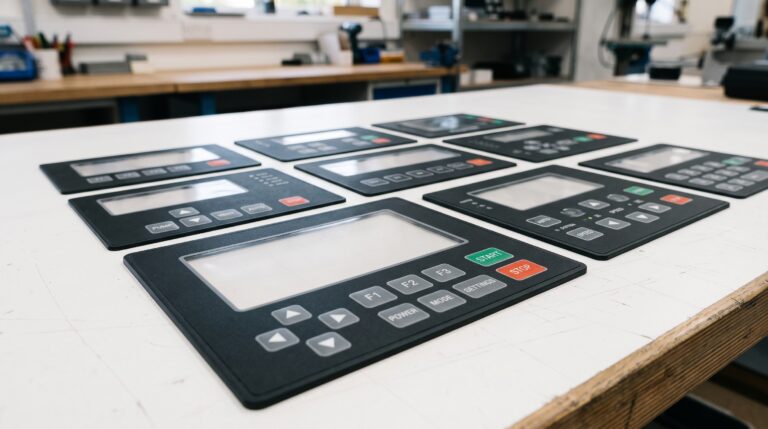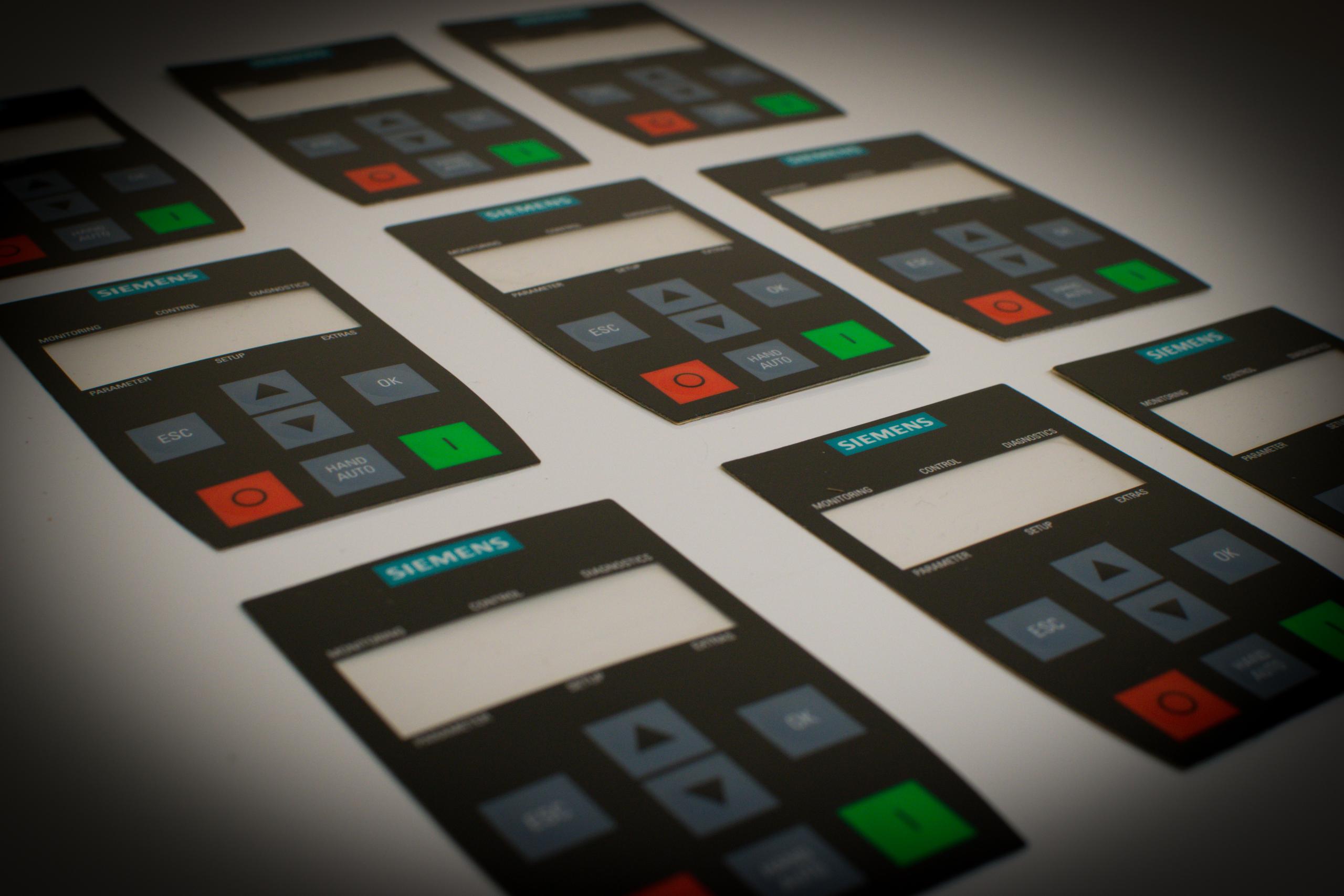
Control Panel Overlay Printing: Screen Print vs Digital Print
A drawing lands on your desk specifying a digitally printed overlay because the artwork includes a photographic background and a tonal gradient behind the logo. The same drawing calls for a Pantone-matched corporate blue across the full fascia, and a dead-front window that must stay invisible until the LED behind it illuminates.
Those requirements do not sit comfortably on the same press. That conflict is the real question behind control panel overlay printing, yet many specifications settle on a process before considering what each element of the design requires.
Screen and digital are different processes. They lay down different quantities of ink in different ways, with consequences for colour accuracy, light transmission and unit cost. Choosing between them starts with identifying which requirements matter most to the finished overlay.
What actually fails on a control panel overlay
It is worth separating print performance from the rest of the construction, because the printing method is not always the reason an overlay fails in service.
Legends may abrade from a fascia on the first surface when the cleaning regime demanded for second-surface printing. Edges can lift when an adhesive specified for flat, dry, room-temperature panel is used on equipment running at 70°C with vibration. A polycarbonate fascia may craze after repeated cleaning with aggressive solvents where polyester would have been better suited.
In most subsurface overlay constructions, both screen and digital graphics are printed in reverse onto the back of a clear polycarbonate or polyester substrate. The substrate then protects the ink from abrasion and direct chemical contact. The adhesive, sub-panel and any embossing also play a major part in how the finished overlay performs in service.
So the honest framing is this: material, construction and adhesive determine how long the overlay survives. The printing method determines what it can look like, how it behaves when backlit, and what it costs per unit. Those are the more useful grounds to decide on.
Where screen printing still wins
The main advantage of screen printed overlays is ink film thickness. A screen deposit is several times thicker than a digital one, which gives it a few practical advantages.
Opacity in a single pass. Solid blocks of colour print dense and even without building layers behind them. On a large fascia with a wide expanse of one colour, screen gives a flatter, more uniform result.
Spot colour fidelity. Ink is mixed to your Pantone or RAL reference before it touches the substrate, rather than being simulated from process colours. That matters for brand-critical work, and it matters even more for repeat orders. A panel run in 2026 can be matched to the same ink standard as one run in 2031.
Predictable light transmission. Dead-front windows, backlit legends and diffusing whites all depend on how much light passes through a translucent ink layer. That is a function of film thickness, and film thickness is exactly what screen printing controls well. If a legend has to disappear completely when unlit and read cleanly when lit, this is the process with the fewest surprises.
Screen printing also handles selective finishes well, including matt or anti-glare varnish over viewing windows, gloss elsewhere, and textured areas over tactile button zones.
The trade-off is setup. Each colour needs its own screen, so cost scales with the number of colours rather than the number of units. A three-colour fascia at 500 off is comfortable. An eleven-colour fascia at 25 off is far less economical.
Where digitally printed overlays earn their place
Digital printing removes the need for individual screens, and artwork can go to press much closer to the supplied file. That changes the economics in several situations:
- Photographic or tonal artwork. Gradients, soft shading and image content that screen printing cannot reproduce cleanly.
- High colour counts. Once you are past four or five colours, additional colours cost nothing extra on a digital press.
- Low quantities. Prototypes, pre-production builds, spares, and small-batch machine variants.
- Variable data. Serial numbers, barcodes, QR codes, asset references and language variants, all within one run.
There are still two important limitations to keep in mind. Process colour cannot reach every Pantone reference; saturated oranges, certain greens and some corporate blues sit outside the achievable gamut, as do metallics. And because the ink film is thinner, opacity for subsurface work is built up with white passes, which adds cost. At volume, that cost advantage over screen narrows or disappears.
Durability is less of a dividing line than it once was. UV-cured inks printed subsurface and protected by the substrate perform well in many indoor and enclosed industrial applications. For prolonged outdoor UV exposure or repeated solvent contact, the material choice and hardcoat specification should still be considered alongside the printing method.
The hybrid approach
Some overlay specifications contain requirements that favour both processes. In those cases, there is no need for every element of the panel to be printed the same way.
A solid background colour, dead-front window or diffusing white behind backlit legends can be screen printed where density and light transmission need tighter control. Photographic artwork, tonal graphics or variable information can then be added digitally.
The same principle works with inserted legends and serialisation. A common screen printed fascia can carry a digitally printed or separately inserted legend panel that changes between machine variants. This allows each process to be used where it is most suitable, without forcing the whole overlay into one printing method.
What to include with your enquiry
A clear quotation starts with the application as well as the artwork. Useful information includes:
- Operating temperature range
- Cleaning chemicals and frequency
- UV exposure
- Whether buttons are embossed or flat
- Whether any areas are backlit
- Pantone, RAL or other colour references
- Batch size and expected annual volume
Lexicraft manufactures bespoke identification products in Britain and produces both screen and digitally printed overlays in house, alongside embossing and sub-panel fabrication. Sending the panel drawing together with the application details gives us enough information to recommend the most suitable print route for the job.
Need help deciding between screen and digital printing? Talk to us about your overlay requirements.